
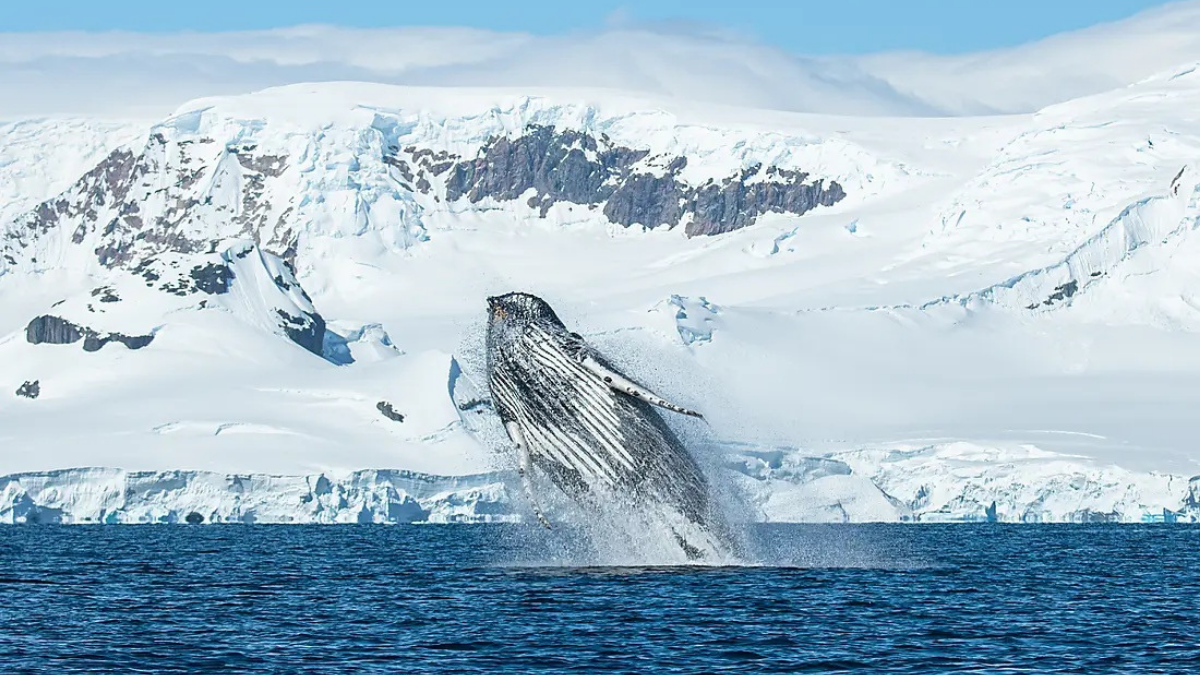
Antarctica is home to some of the most extraordinary wildlife on Earth, and this Antarctica wildlife guide is your complete hub for understanding what you might encounter, no matter which species matter most to you.
From seven penguin species to whales, seals, and seabirds, no other continent offers wildlife encounters quite like this — animals with little fear of humans, visible in numbers that are genuinely difficult to comprehend until you’ve experienced them firsthand.
This guide covers every major species group you might see on an Antarctic voyage, with links through to dedicated deep-dive guides for anything you want to explore further, plus itinerary guidance if a specific species is the reason you’re making this trip.
Penguins of Antarctica
For most travelers, penguins are the reason Antarctica exists in the imagination at all, and the continent delivers on that promise. There are seven species, and they’re easier to tell apart than you’d think — it’s nearly all in the head markings.
Gentoo penguins are among the easiest to identify, with a white stripe arcing across the top of the head and a bright orange-red bill. They’re common across the Peninsula and South Shetland Islands, and tend to be one of the calmer, less noisy species compared to their neighbors.
Chinstrap penguins get their name from the thin black line under their chin, which looks like a strap holding on a helmet. They’re found in large, noisy colonies on sites like Deception Island and Half Moon Island.
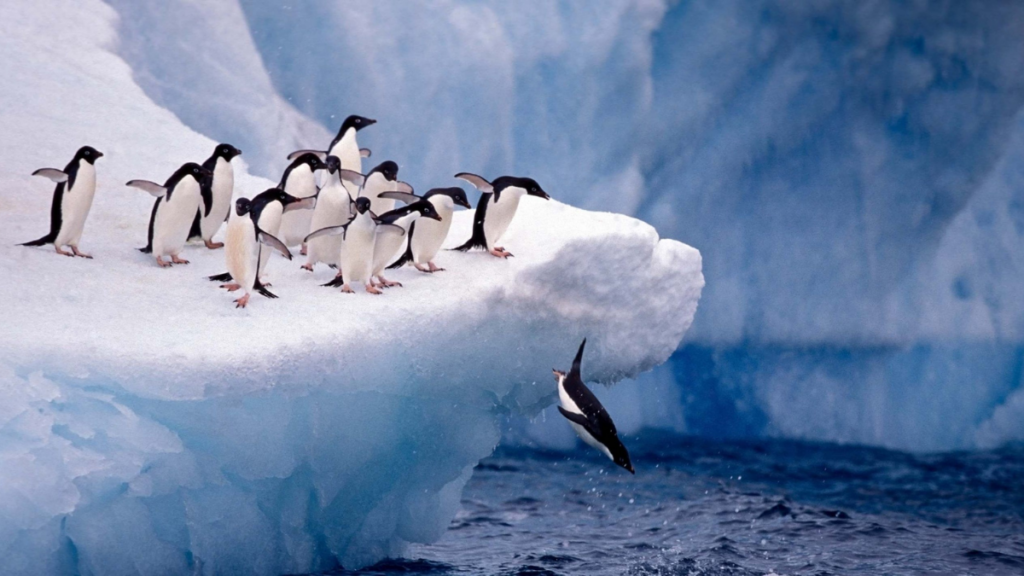
Adélie penguins are the classic “tuxedo” penguin, all black and white with a distinctive white ring around each eye. They’re found across the Peninsula and further south, and are known for their high energy and near-constant activity around the colony.
King penguins are taller and sleeker than the three species above, with vivid orange-and-black head markings. They’re found primarily on South Georgia, home to some of the largest king penguin colonies on Earth, including the famous Salisbury Plain colony estimated at well over 100,000 breeding pairs.
Emperor penguins are the largest and most iconic penguin species on the continent, and the only one that breeds during the Antarctic winter, incubating a single egg on the sea ice through total darkness. Sightings require specific itineraries, typically into the Weddell Sea or Ross Sea regions, since emperors don’t breed at most standard Peninsula landing sites.
Macaroni penguins, recognizable by distinctive yellow-orange feather plumes above the eyes, are occasionally seen on South Georgia and sub-Antarctic islands, though they’re less common than the species above.
Rockhopper penguins are the smallest and most entertaining of the lot — spiky yellow plumes, red eyes, and a permanently affronted expression. True to the name, they don’t waddle; they bounce, both feet together, up rock faces that look far too steep for them. They fall off regularly and immediately try again. Found on the Falklands, on itineraries that include the sub-Antarctic islands.
Best itinerary for penguins: A standard Peninsula voyage reliably delivers gentoo, chinstrap and Adélie. King penguins mean South Georgia, and rockhoppers mean the Falklands — both of which are covered on the longer combined itineraries. Emperors mean a specialized Weddell or Ross Sea trip, which is a genuinely different kind of expedition.
Whales of Antarctica
Several whale species pass through Antarctic waters during the summer feeding season, drawn south by the seasonal krill bloom that fuels much of the ecosystem.
Humpback whales are the most commonly seen, with long pectoral fins and that distinctive hump before the dorsal fin as they dive. They’re also the ones that bubble-net feed — several whales circling a krill swarm, blowing a wall of bubbles to trap it, then surfacing through the middle with their mouths open. Watching it happen is one of those moments where the whole Zodiac goes quiet.
Minke whales are smaller and faster than humpbacks, with a pointed snout. Usually the first whale species of the season, and often curious enough to come and have a look at you.
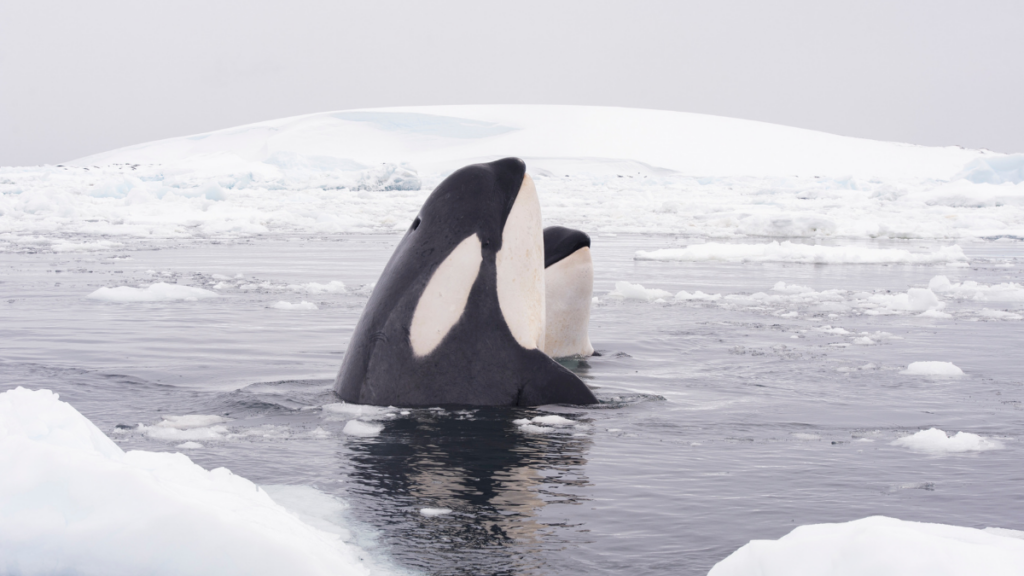
Orcas, or killer whales, are unmistakable with their striking black-and-white coloring and tall, upright dorsal fin, particularly prominent in adult males. Several distinct ecotypes are found in Antarctic waters, each with different hunting behavior and prey preferences.
Blue whales, the largest animal on Earth, are occasionally sighted in Antarctic waters, though they are far less common than humpbacks or minkes. Rare, and unforgettable when it happens.
Southern right whales, recognizable by the absence of a dorsal fin and distinctive white callosities on the head, are occasionally seen, though more associated with sub-Antarctic waters than the Peninsula itself.
Best itinerary for whales: February is widely considered the peak month for whale watching across the Antarctic season, with humpbacks, minkes, and orcas all active and easier to spot. If whales are your top priority, look specifically for later-season departures (February in particular) rather than early-season voyages, when whale numbers are still building.
Seals of Antarctica
Six seal species inhabit Antarctic waters, each with genuinely distinct behavior and appearance worth knowing before you go.
Elephant seals Elephant seals are the largest seals on Earth, easily recognized by their enormous size. Males have an absurd trunk-like snout that they use to bellow at rivals. Breeding season peaks in October, when dominant males engage in dramatic, thunderous battles for beach territory. They are found mainly on sub-Antarctic islands, especially South Georgia and the Falklands, both home to large colonies. You’re unlikely to spot them on Antarctic Peninsula itineraries.
Fur seals are smaller, with visible ear flaps and a dog-like gait on land that distinguishes them from true seals. They can be feisty and territorial, particularly on beaches shared with penguin colonies, and guides will typically remind you to keep a safe distance.
Crabeater seals are one of the most abundant seal species on Earth. Their name is rather misleading, since they actually feed almost exclusively on krill rather than crabs. They’re commonly seen hauled out on ice floes, looking entirely untroubled.
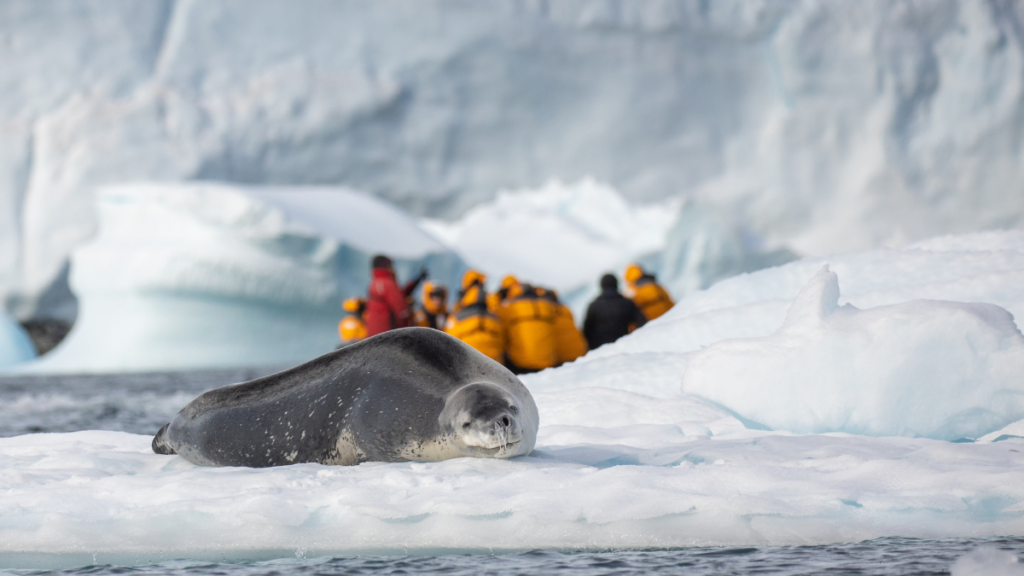
Leopard seals are long, slender, and reptilian in appearance, with a spotted coat, and are one of the few active predators of penguins in Antarctic waters. Most visible January through March, patrolling the water while the penguins at the shoreline work up the nerve to go in.
Weddell seals are found further south than most other species and are one of the few animals that remain in Antarctica through the winter, using breathing holes to survive beneath the sea ice.
Ross seals are the least commonly seen Antarctic seal, generally found in the pack ice further from typical landing sites, making sightings a genuine rarity even for experienced polar travelers.
Best itinerary for seals: Elephant seal breeding behavior peaks in October-November, so early-season departures are ideal if that’s your priority. Leopard seal activity is most visible January through March. For the rarer Weddell and Ross seals, itineraries pushing further south, including Crossing the Circle voyages, offer better odds than a standard Peninsula-only trip.
Seabirds of Antarctica
Beyond penguins, Antarctica hosts a genuinely rich seabird population that’s easy to overlook amid the more headline-grabbing species.
Wandering albatross have the largest wingspan of any living bird, and watching one glide beside the ship for minutes without a single flap recalibrates your sense of scale. Best seen crossing the Drake and around South Georgia.
Skuas, both brown and south polar varieties, are large, aggressive predatory seabirds that patrol penguin colonies for unguarded eggs or chicks.
Petrels, including snow petrels, Antarctic petrels, and Wilson’s storm-petrel, mostly feed on krill and fish, and nest on cliffs and rocky outcrops throughout the region.
Giant petrels are a notable exception among petrels, known to scavenge carcasses and occasionally prey on chicks themselves if given the opportunity.
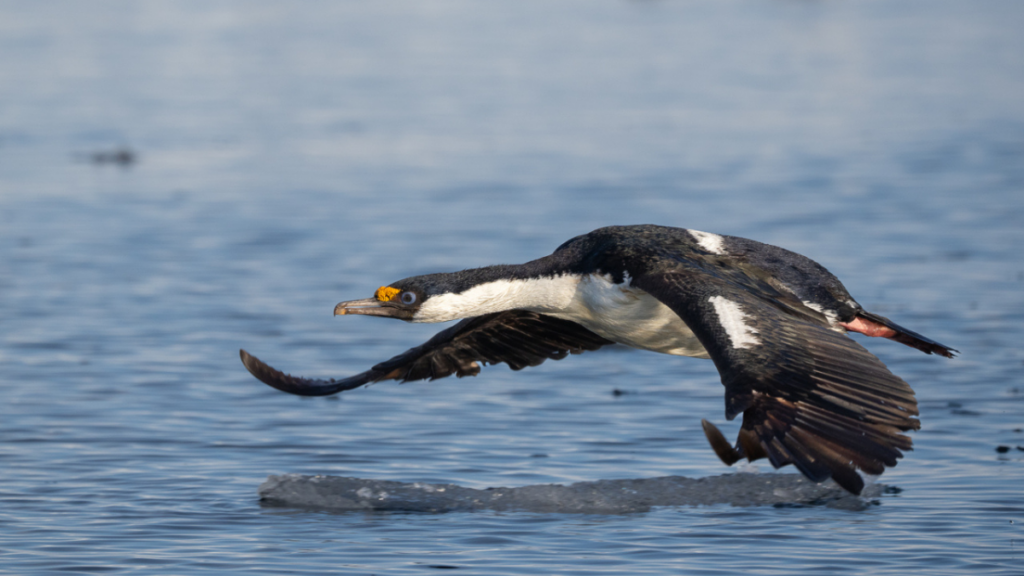
Antarctic blue-eyed shags, a type of cormorant with a striking blue eye-ring, nest near penguin colonies at sites like Paulet Island and Port Lockroy.
Kelp gulls are common, opportunistic scavengers seen throughout the Peninsula.
Best itinerary for seabirds: Albatross sightings are strongest during the Drake Passage crossing and around South Georgia, so itineraries that include South Georgia offer the richest seabird diversity overall.
When to Go, by Species
Timing your voyage around a specific species matters more than many first-time travelers expect. Here’s a quick reference:
| Priority Species | Best Month(s) | Itinerary Note |
| Gentoo, Chinstrap, Adélie penguins | November–March (peak: January) | Any standard Peninsula voyage |
| King penguins | Year-round | Requires South Georgia |
| Emperor penguins | November–December (breeding) | Requires Weddell Sea or Ross Sea itinerary |
| Rockhopper penguins | October–February | Requires Falklands |
| Macaroni penguins | October–February | Requires South Georgia or sub-Antarctic islands |
| Elephant seals (breeding) | November | Early-season departure |
| Leopard seals | January–March | Any standard voyage |
| Weddell / Ross seals | Less predictable | Crossing the Circle or further south |
| Humpback, minke whales | December–March | Any standard voyage |
| Orcas | January–February | Peak-season departure |
| Albatross and seabird diversity | November–March | Voyages including South Georgia |
Where You’re Sailing Matters Too
Wildlife distribution across Antarctica isn’t uniform, so where your itinerary takes you matters as much as when you go. Our Antarctic Peninsula guide covers the specific landing sites most standard voyages visit and what you’ll typically find at each.
If your itinerary pushes further into the Weddell Sea, expect a genuinely different wildlife profile, including your best chance at emperor penguins and Weddell seals, though access is never guaranteed given how ice-dependent this region is.
If you’re planning to photograph your encounters, our Photography Guide covers gear and technique specific to capturing wildlife in polar light and conditions, which behave quite differently from typical wildlife photography elsewhere.
Ready to Plan Your Wildlife-Focused Antarctica Expedition?
Antarctica’s wildlife is extraordinary no matter when or where you go, but knowing what to expect, and when, helps you build a voyage around what matters most to you. If you’d like help choosing the itinerary that maximizes your chances of seeing specific species, get in touch with us — we’ve spent 25 years matching travelers to the right Antarctic voyage for exactly what they want to see.