
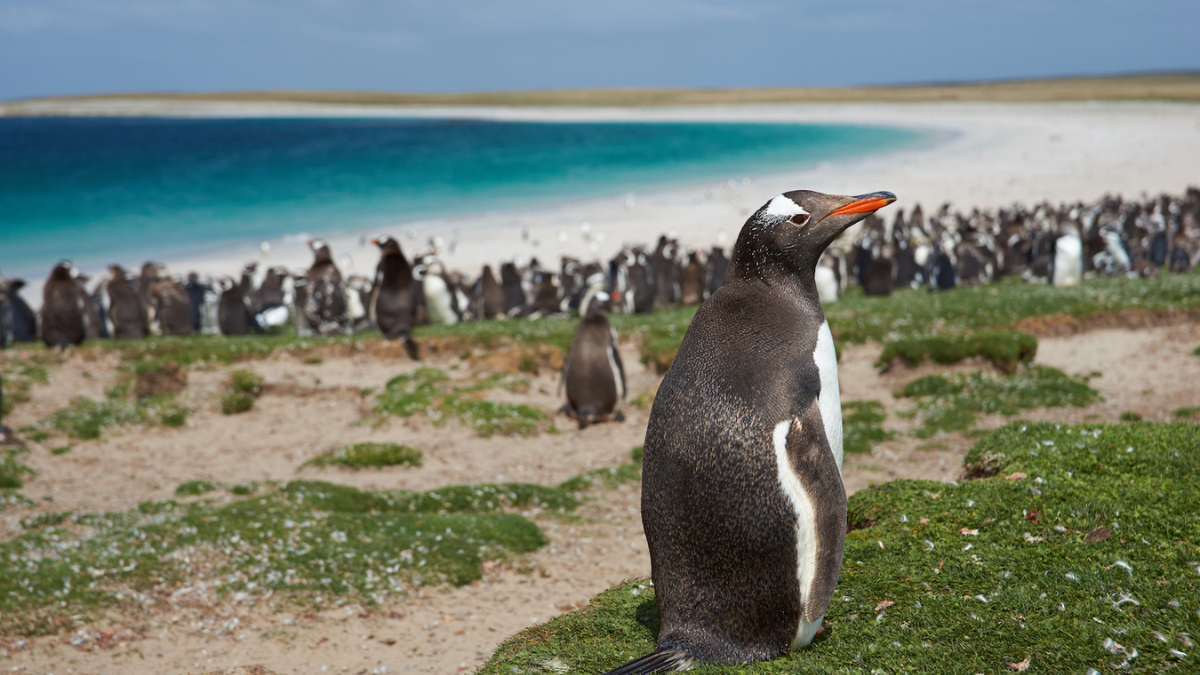
Most people treat the Falklands as the warm-up act — the stop before South Georgia, before Antarctica, before the serious stuff. Then they land on a white-sand beach in bright sunshine, watch a Magellanic penguin emerge from a burrow at their feet, and spend the rest of the voyage telling anyone who’ll listen that the Falklands were the surprise of the trip.
This Falkland Islands wildlife guide covers what’s actually there — the species, the landscape, the history, and the slightly disorienting experience of finding a corner of rural Britain sitting in the South Atlantic.
What to Expect When You Arrive
The first thing that throws people is the weather. You’ve packed for Antarctica, and the Falklands are comparatively mild — windy, certainly, but nothing like the cold waiting further south. The second thing is the color. After days of grey ocean, the beaches here are genuinely white sand, the water turns turquoise in the shallows, and if you saw a photograph without context, you’d guess somewhere tropical.
Then a penguin walks across the frame and ruins the illusion entirely.
The archipelago has over 700 islands, though expedition itineraries typically visit a handful: Stanley, the capital, plus one or two of the outer islands where wildlife concentrations are at their best.
The Wildlife
Penguins
Five penguin species breed in the Falklands, which is more than you’ll find anywhere else on a standard Antarctic itinerary.
Gentoos are everywhere, and Falklands gentoo colonies sit on grass and sand rather than rock and snow, which makes for a very different photograph than you’ll get further south.
Magellanic penguins are the Falklands speciality, and they’re the ones that surprise people. They nest in burrows — actual holes in the ground — so you’ll be walking across what looks like ordinary grassland when a penguin emerges from beneath your feet. They’re also called jackass penguins for a reason you’ll understand within about ninety seconds of arriving: the braying call is startlingly loud and sounds nothing like you’d expect a bird to produce.
Rockhoppers are here too, small and red-eyed with those ridiculous yellow plumes, bouncing up rock faces with both feet together and falling off at regular intervals. They cluster on cliff-edge colonies, often alongside the shags, and they’re worth the walk.
King penguins breed at Volunteer Point, a colony that requires a land excursion rather than a ship landing but rewards the effort. It’s the most northerly breeding king colony in the world.
Macaronis turn up occasionally, usually tucked into rockhopper colonies, looking faintly like they’ve wandered into the wrong party.
Albatross and Seabirds
Black-browed albatross breed here in enormous numbers — the Falklands host a substantial share of the global population — and standing near a cliff-edge colony while they come in to land is one of those moments that recalibrates your sense of how big a bird can be.
Beyond albatross, expect striated caracaras (locally called johnny rooks, intelligent and shamelessly nosy — they’ll investigate your bag if you leave it unattended), king cormorants, and a long list of smaller species that keep the birders on board very happy indeed.
Marine Mammals
Elephant seals and sea lions haul out on the beaches, and Commerson’s dolphins — small, strikingly black-and-white, and genuinely playful — frequently ride the bow wave of Zodiacs on the way in.
Orcas patrol some coastlines hunting seal pups, a food chain operating in plain view and not for the squeamish.
Stanley: A Small Piece of Britain, 8,000 Miles Away
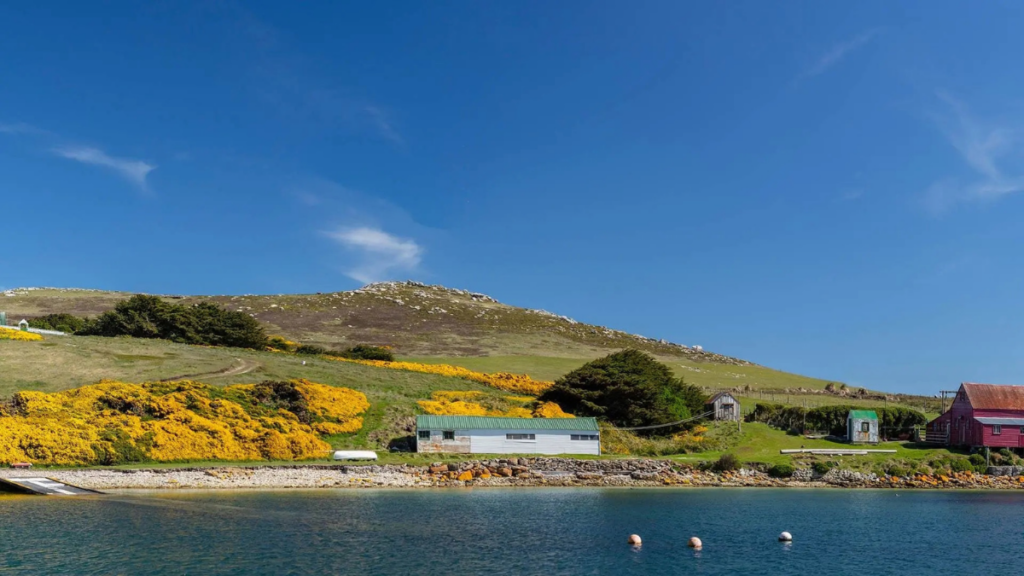
Stanley is where the Falklands get properly strange, in the best way. You’ve been at sea for days. You come ashore, and there’s a red telephone box. A pub. Union flags. Street names like Ross Road. Gardens with hedges. Roughly 2,500 people live here, about three-quarters of the islands’ entire population.
It’s a working town rather than a tourist set piece, and that’s rather the point. The cathedral has an arch made from whale jawbones. The museum covers the islands’ maritime and settlement history properly. And the pubs serve exactly what you’d expect, which after a week of ship food lands better than it has any right to.
The History
The Falklands have been contested for most of their recorded history, claimed at various points by France, Spain, Britain and Argentina, with British administration established in 1833 and maintained since.
That dispute came to a head in 1982, when Argentina invaded, and Britain responded with a naval task force sent 8,000 miles south. The conflict lasted 74 days and cost 649 Argentine and 255 British lives, along with three Falkland Islanders.
The war is not distant history here. Memorials stand in Stanley and at battle sites across the islands; minefields were only fully cleared in 2020, and many residents lived through the occupation. Islanders voted overwhelmingly to remain a British Overseas Territory in a 2013 referendum, though Argentina maintains its claim. It’s worth arriving with some awareness of all this — it’s a live subject, and locals will discuss it openly if asked respectfully.
Before the war, the islands’ story was shaped by the sea: wrecked ships sheltering in Stanley harbor, sealing and whaling crews, and sheep farming, which remains a significant part of island life.
Falklands at a Glance
| Site/Feature | Known For |
| Penguin species | Gentoo, Magellanic, rockhopper, king, occasional macaroni |
| Key seabird | Black-browed albatross |
| Marine mammals | Elephant seals, sea lions, Commerson’s dolphins, orcas |
| Capital | Stanley (population ~2,500) |
| Best time to visit | October–March, aligning with the expedition season |
| Typical itinerary | Combined with South Georgia and the Antarctic Peninsula |
How the Falklands Fit Into Your Voyage
The Falklands are rarely a destination on their own. They’re almost always the first stop on a longer itinerary heading east to South Georgia and then south to the Antarctic Peninsula — the “full” Antarctic voyage, typically two to three weeks rather than the ten to twelve days of a Peninsula-only trip.
That extra time is the trade-off. You’ll spend more days at sea than on a direct Peninsula crossing, but you’ll see species and landscapes a shorter voyage simply can’t reach. Our South Georgia and Falklands itineraries cover what those routes involve, and travelers planning from Britain will find route details on our Antarctica from the UK page.
Ready to Include the Falklands in Your Expedition?
For British travelers especially, there’s something genuinely odd and rather wonderful about finding a red phone box and a pub at this latitude, surrounded by penguins. If you’d like help planning an itinerary that includes the Falklands alongside South Georgia and the Peninsula, get in touch with us — we’ve been matching travelers to the right voyage for 25 years. For the wider picture of what you’ll encounter on the way south, our Antarctica wildlife guide covers every species you’re likely to meet.