
For most travelers, penguins are the reason Antarctica exists in the imagination at all, and the continent and its surrounding sub-Antarctic islands deliver on that promise across seven distinct species.
This field guide covers every penguin species you might encounter on an Antarctic voyage, how to identify each one, where you’re most likely to see them, and the best time of year to do so.
Penguin Species in Antarctica: What to Know Before You Go
Here’s one thing you’ll discover: you’ll smell the colony before you see it. Guano, mostly, with a sharp krill-and-ammonia edge to it that catches in the back of your throat. Within five minutes, you’ll stop noticing, because a gentoo will waddle over to inspect your boots and the smell will be forgotten.
The species you’re likely to meet depends almost entirely on where your ship goes. Three species — gentoo, chinstrap, and Adélie — are the reliable stars of any standard Antarctic Peninsula voyage, found at the landing sites most ships visit. The remaining four require either a sub-Antarctic detour or, in the case of the emperor penguin, a genuinely specialized expedition.
Telling them apart is easier than you’d think, since each species has at least one distinctive feature that sets it apart clearly, even at a distance. Head markings do most of the work: a white stripe across the crown, a black line beneath the chin, a white eye-ring, or a spray of yellow plumes above the eyes. Once you’ve learned these few markers, telling species apart becomes second nature, and by day two of your voyage, you’ll have the confidence of a lifelong ornithologist.
Timing changes what you see just as much as location does. Arrive in November, and you’ll catch the courtship — the bowing, the calling, the elaborate business of nest-building, which mostly involves stealing pebbles from the neighbors when they’re not looking.
Come in December or January, and colonies are alive with chicks at various stages of growth. Travel in February or March, and you’ll see fledging birds testing the water for the first time.
Here’s what to look for, species by species.
Gentoo Penguin
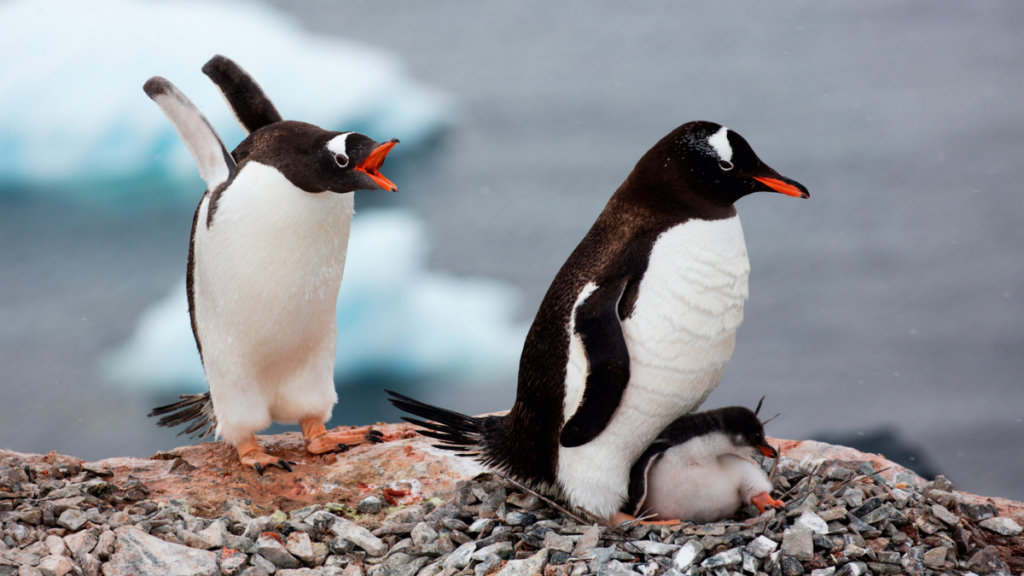
Gentoo penguins are among the easiest species to identify, with a distinctive white stripe arcing across the top of the head and a bright orange-red bill that stands out clearly even at a distance — handy to identify when you’re squinting through spray from a Zodiac.
They’re the calmest of the Peninsula three, and comparatively quiet, which photographers tend to appreciate. You can sit with a gentoo colony for an hour and actually watch behavior unfold, rather than be assaulted by noise. They’re also the ones most likely to wander over and have a good look at you; not tame, exactly, just entirely unbothered.
Where to see them: Common across the Peninsula and South Shetland Islands, including sites like Cuverville Island.
Best time to see them: November through March, with chicks visible from December onward.
Chinstrap Penguin
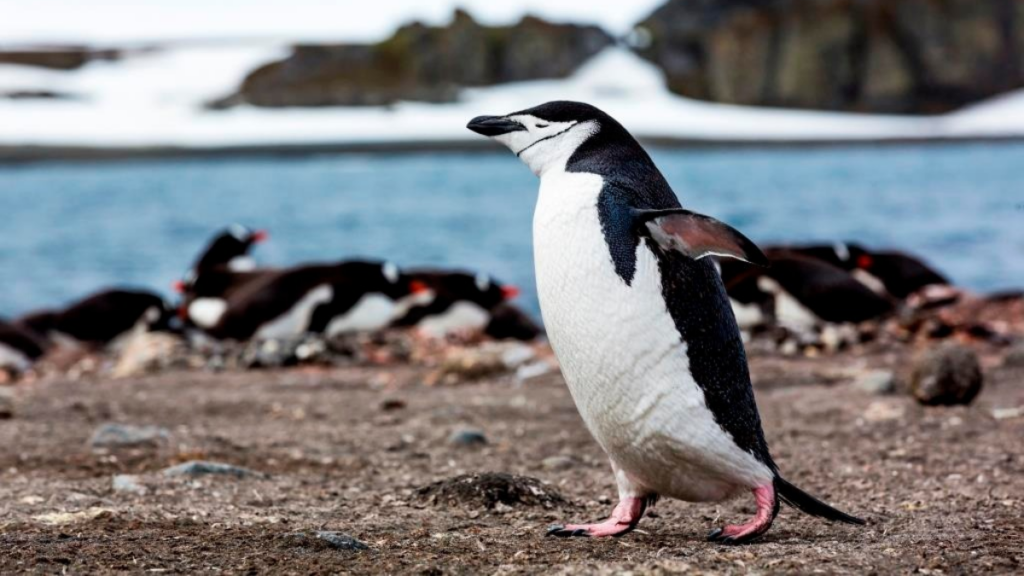
Chinstrap penguins get their name from the thin black line running beneath the chin, giving the appearance of a strap holding on a helmet.
They are the loud ones. Densely packed, permanently vocal, and they don’t seem to stop. Stand near a big chinstrap colony, and the noise is genuinely something: a constant, braying racket coming from every direction at once. Plus, there’s always something to see, as they are the most argumentative penguin on the Peninsula: expect to see neighbours bickering and pebbles being stolen.
Where to see them: Large colonies at sites like Deception Island and Half Moon Island.
Best time to see them: November through March, peak chick activity in January.
Adélie Penguin
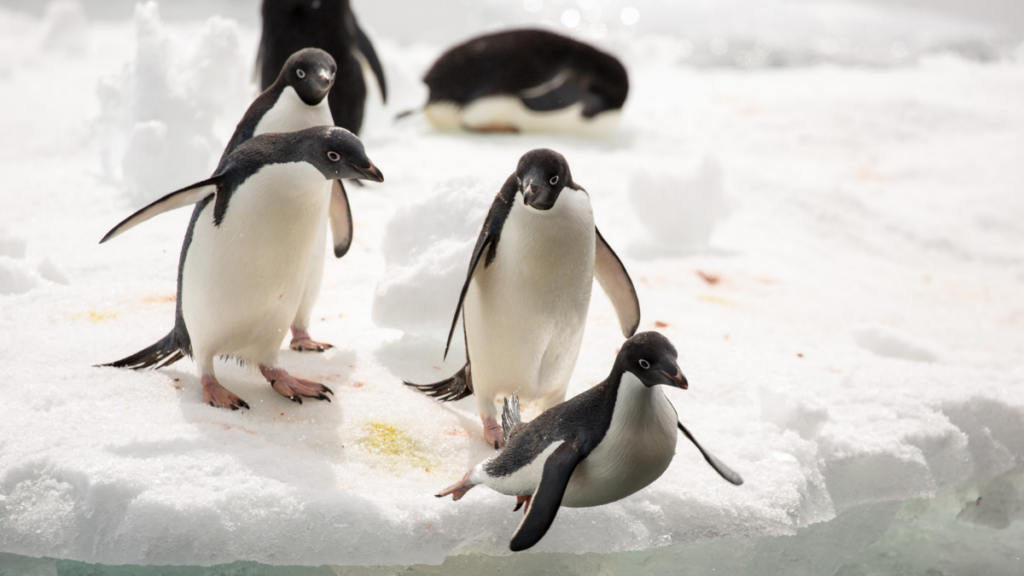
The Adélie penguin is the classic “tuxedo” penguin that a child draws. They are black and white, with a distinctive white ring around the eye that gives them a permanently startled look.
They are the busiest penguin on the Peninsula. They run, they tumble, they march with purpose. And they’re fearlessly curious — an Adélie will come and stand near you simply because you’re new and interesting.
Expect to be told to hold still by your guide, and let the penguin decide what it thinks. It usually decides you’re fine, and wanders off.
Where to see them: Found across the Peninsula and further south, including Paulet Island.
Best time to see them: November through March, with the species tending to arrive slightly earlier in the season than gentoos and chinstraps.
Emperor Penguin
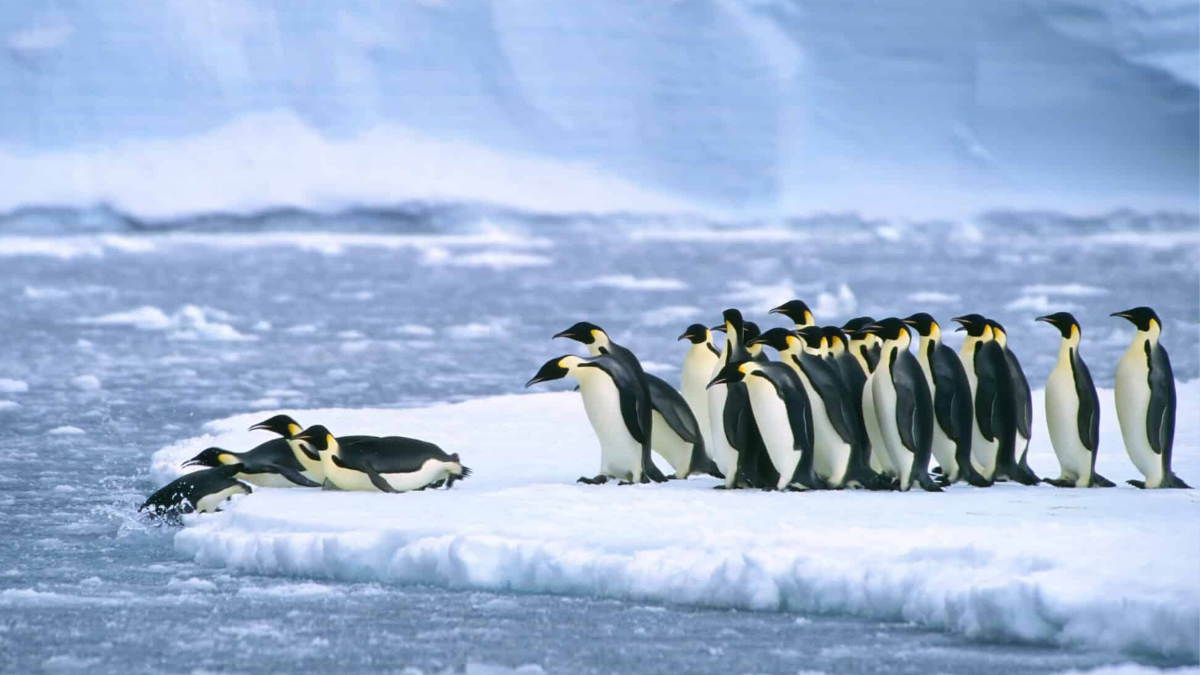
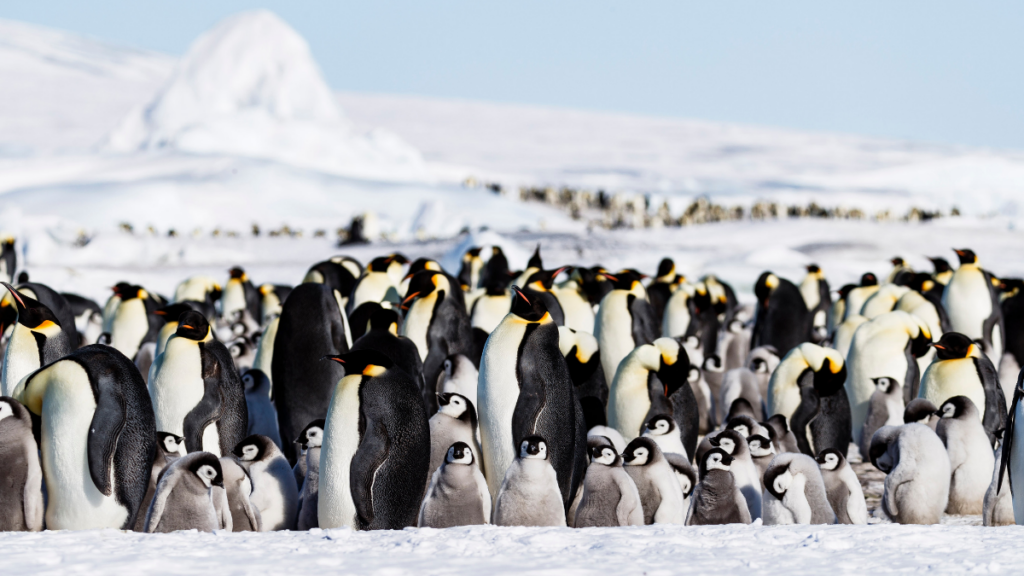
The emperor penguin is the one that stops conversation. They are the largest penguin on Earth, and the only bird anywhere that breeds through the Antarctic winter — a single egg balanced on the feet, through months of darkness, in temperatures that don’t bear thinking about.
Seeing one isn’t luck on a standard voyage. Emperors don’t breed where most ships go, so it takes a completely different kind of trip. But standing on sea ice, in front of an emperor colony is, by common agreement among people who’ve done both, in a different category from anything else on this list.
The emperor penguin is the largest penguin species on Earth, and the only one that breeds during the brutal Antarctic winter, incubating a single egg on sea ice through total darkness. Seeing one requires a genuinely different kind of trip from a standard Peninsula voyage, since emperors don’t breed at the sites most itineraries visit.
Where to see them: Almost exclusively at Snow Hill Island in the Weddell Sea, reachable only via specialized helicopter-equipped voyages.
Best time to see them: November and December specifically, earlier than most standard Antarctic departures.
King Penguin
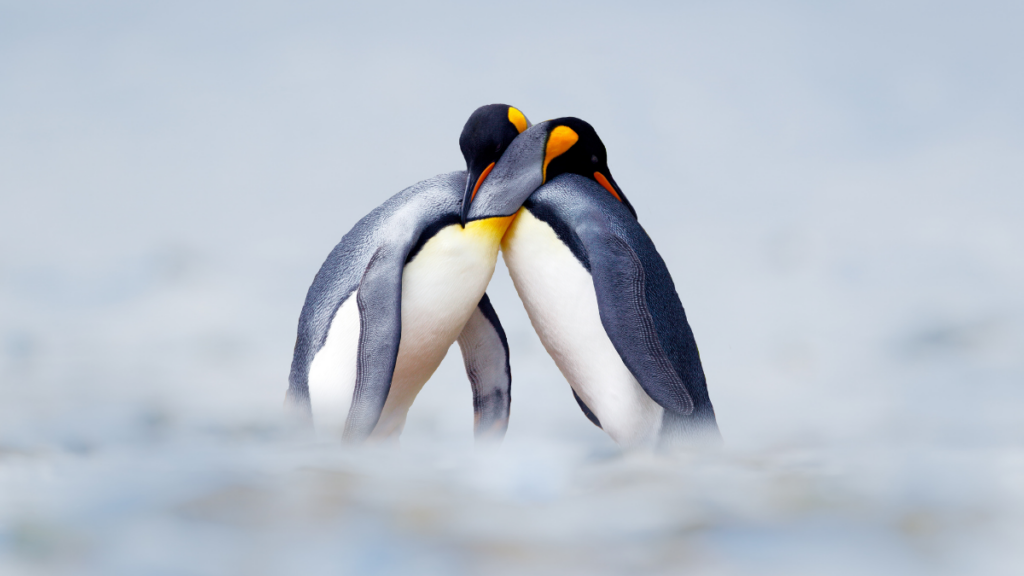
Taller, sleeker, with vivid orange-and-black head markings, king penguins are the most composed of the penguin species in Antarctica.
Their breeding cycle runs long — over a year — so a king colony contains chicks at every stage at once, including the “oakum boys”, enormous brown fluffy things that look absolutely nothing like their parents, so much so that early explorers genuinely classified them as separate species. Seeing a chick larger than the adult beside it, dressed in what appears to be a badly-fitted fur coat, never quite stops being funny.
King penguins are taller and sleeker than the three Peninsula species above, with vivid orange-and-black head markings and a notably more elegant bearing. Their breeding cycle is unusually long, meaning colonies host chicks at every stage of development simultaneously, from newly hatched to fully grown “oakum boys” still waiting for adult plumage.
Where to see them: Primarily South Georgia, home to some of the largest king penguin colonies on Earth, including the famous Salisbury Plain colony, estimated at well over 100,000 breeding pairs.
Best time to see them: Year-round, given their extended breeding cycle, though October through January is generally considered peak season for overall wildlife activity on South Georgia.
Macaroni Penguin
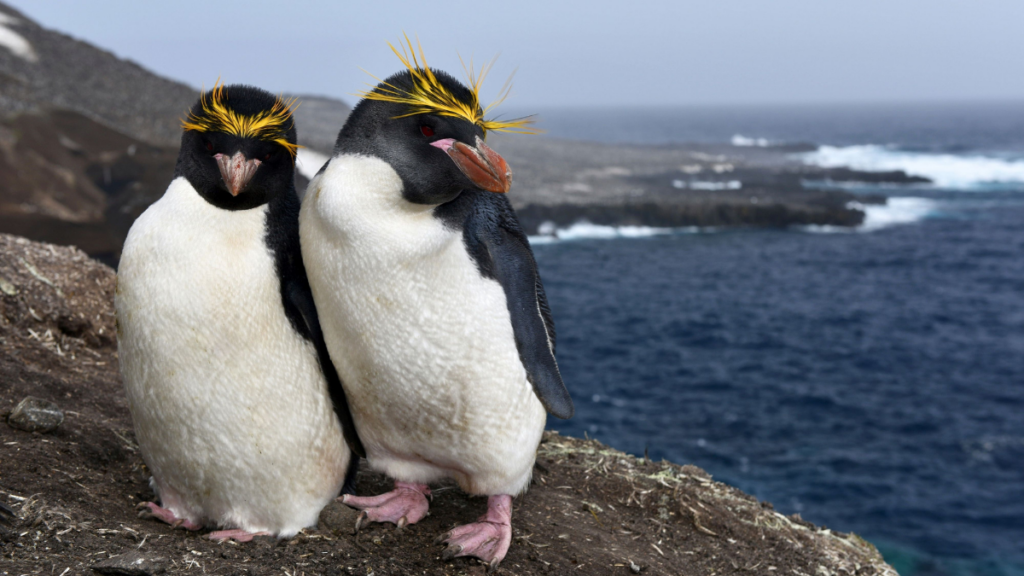
Macaroni penguins are recognizable by their distinctive yellow-orange feather plumes above the eyes, giving them a genuinely striking, almost theatrical appearance compared to other Antarctic species.
They’re less commonly encountered than the species above, since they stick to specific sub-Antarctic breeding sites rather than the Peninsula itself. Worth the detour if your itinerary allows — it’s a face you don’t forget.
Where to see them: South Georgia and other sub-Antarctic islands.
Best time to see them: October through February, aligning with the broader South Georgia wildlife season.
Rockhopper Penguin
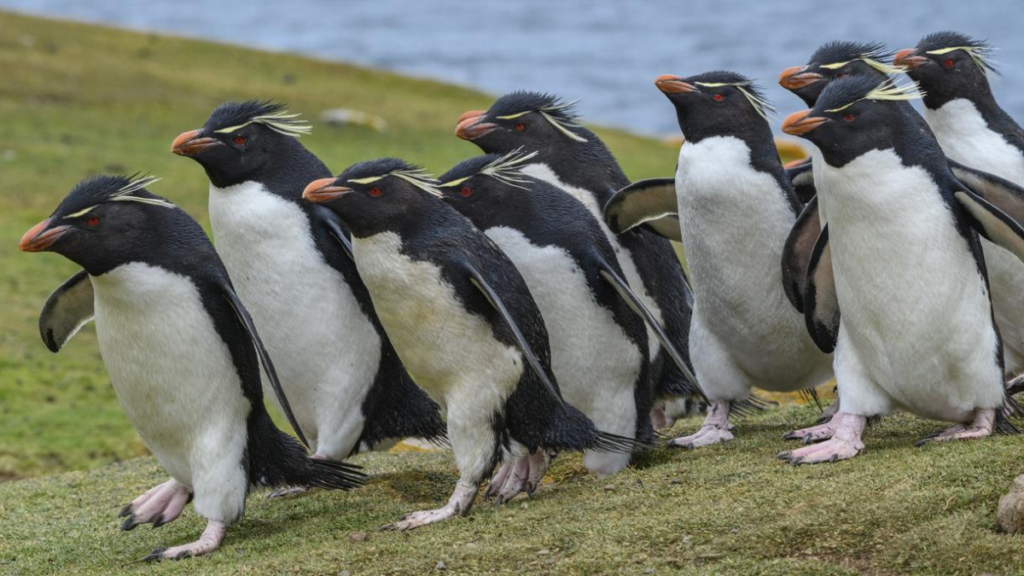
Small, red-eyed, spiky-plumed, and permanently furious-looking, the rockhopper is the one that makes everyone laugh.
The name is entirely literal: rockhoppers don’t waddle; they bounce, both feet together, up boulder faces that look far too steep for a bird of their size. They fall off regularly, but get up and do it again.
Pound for pound, they’re also the feistiest penguin here, quite happy to take on something several times their size, which they do with the air of a bird who has never once considered losing.
Where to see them: Sub-Antarctic islands including the Falklands, on itineraries that include this region alongside South Georgia and the Peninsula.
Best time to see them: October through February, similar to macaroni penguins.
Penguin Species of Antarctica at a Glance
| Species | Key ID Feature | Where to See Them | Best Time |
| Gentoo | White head stripe, orange-red bill | Peninsula, South Shetlands | Nov–March |
| Chinstrap | Black line under chin | Deception Island, Half Moon Island | Nov–March (peak: Jan) |
| Adélie | Black and white, white eye-ring | Peninsula, further south | Nov–March |
| Emperor | Largest species, breeds on winter sea ice | Snow Hill Island (Weddell Sea) | Nov–Dec |
| King | Tall, orange-and-black head markings | South Georgia | Year-round (peak: Oct–Jan) |
| Macaroni | Yellow-orange head plumes | South Georgia, sub-Antarctic islands | Oct–Feb |
| Rockhopper | Spiky plumes, red eyes | Falklands, sub-Antarctic islands | Oct–Feb |
Choosing the Right Itinerary for Penguin Species
Which penguin species you’ll see depends heavily on your specific itinerary. A standard Antarctic Peninsula voyage reliably delivers gentoo, chinstrap, and Adélie penguins. If king, macaroni, or rockhopper penguins are a priority, look for itineraries that include South Georgia and the Falklands alongside the Peninsula. If the emperor penguin is the goal, you’ll need a specialized Weddell Sea voyage, since this is a genuinely different trip from a standard departure.
Timing also matters beyond species alone — for a full breakdown of when to travel for the best overall wildlife experience, see our guide: When Is the Best Time to Visit Antarctica?
Ready to Plan Your Penguin-Focused Voyage?
Seven species, each with its own personality, appearance, and best viewing window, make Antarctica and its surrounding islands one of the richest penguin-watching destinations on Earth.
If you’d like help choosing the itinerary that maximizes your chances of seeing specific species, get in touch with us — we’ve spent 25 years matching travelers to the right Antarctic voyage for exactly what they want to see. For the complete picture of Antarctic wildlife beyond penguins, head back to our main Wildlife Guide.