Sort by

From Saint-Pierre and Miquelon, a small French territory off the North American coast, sail along the magical waters of the St. Lawrence, where the ocean धीरे gradually becomes a river. From the red cliffs of the Magdalen Islands to the spectacular fjords of Newfoundland, via the remote outposts of Providence Island and Harrington Harbour (accessible only by boat).
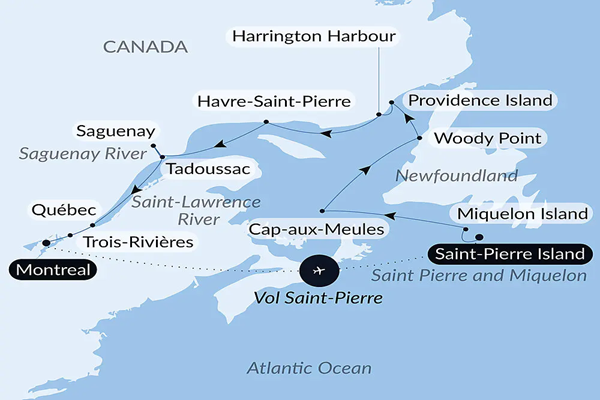
Please note: This itinerary is meant to serve as a general guide. Plans may change along the way, depending on weather, sea conditions, or choices made by the Expedition Leader and team to give you the safest and most rewarding experience.
Embarkation day – Montreal/Saint-Pierre and Miquelon
Flight Montreal/Saint-Pierre and Miquelon.
Approximate flight duration: 4 h 30.
Famous for its gentle way of life, Montréal, Canada’s second-largest city, is a warm and cosmopolitan metropolis. Situated on the eponymous river island, it is home to a multitude of districts, each as unique as the other. Set off to discover Old Montréal, most of which is declared a historic area, Little Italy, where you’ll be able to stroll around the largest open-air market in North America, or the Golden Square Mile, the luxurious district located on one of the hills of Mount Royal and which has sumptuous Victorian-style residences. Simultaneously marked by the influences of the Old Continent and North-American gigantism, Montréal will never cease to amaze you.
Off the Canadian coast, discover Saint Pierre Island, one of the two main islands of the Saint Pierre and Miquelon archipelago, the only French territory in North America. Endowed with a natural harbour, the island, whose name is a reference to the patron saint of fishermen, developed around the fishing industry and still has many traces of its past today. Whale hunting, cod fishing, alcohol smuggling during the Prohibition: all of these memories are still very much alive in the capital, Saint-Pierre. The island is also renowned for the observation of exceptional fauna including, among others, whales, fin whales, dolphins, seals, puffins and petrels.
At the entrance of the Gulf of Saint Lawrence, not far from the Grand Banks of Newfoundland, Miquelon is one of the two main islands of the Saint Pierre and Miquelon archipelago and will delight those with a love of wide open space. Connected by a sand isthmus, with Miquelon in the north and Langlade to the south, this wild land is famous as the home to France’s only boreal forest and has sublime scenery of hills, dotted with ponds, woods and bogs, and ringed by lagoons and steep cliffs. The rich and varied wildlife will guarantee fine encounters, whether inland, which is populated with white-tailed deer and bald eagles, or on the coast, refuge to many seabirds and common seals.
Although it is the administrative and economic centre of the Magdalen Islands archipelago, in the Gulf of Saint Lawrence, the village of Cap-aux-Meules remains a peaceful location and is ideal for exploring preserved nature. Located on the eponymous island, in reference to the sandstone rocks of the cape that were used in the past to make grindstones, the location is above all considered to be the maritime gateway to the archipelago. In this respect, it offers privileged access to many sites renowned for their natural and historic heritage, such as the village of Havre-Aubert which is a member of the Most Beautiful Villages of Quebec.
After riding in an inflatable dinghy around granite tabular islands that are highly characteristic of Basse-Côte-Nord, you will land on an island once occupied by fishermen from Tête-à-la-Baleine and now the summer village of some twenty families. Your guide will take you to a cairn from which you will be able to enjoy a spectacular view over the tundra scattered with a few bushes, moss and white lichen. You will visit the Sainte-Anne Chapel, a beautiful wooden church built in the late 19th century, and taste some local products made from berries.
This small fishing village on Canada’s North Shore is unique in more ways than one: it has very few inhabitants, no cars and a network of wooden pavements linking all the houses together. Lying three kilometres from the coast, the island has extraordinary wild landscapes. It is also home to the Jacques Cartier monument, commemorating the famous French explorer’s visit to the region in 1535. The main activities include walking through the town and strolling along the wooden pavements among the typical village houses. According to legend, the explorer Jean-François de La Rocque de Roberval abandoned his niece Marguerite here in the 1540s when she fell in love with a sailor. She supposedly took refuge in a cave on the island before being rescued by fishermen. The cult Quebec film, Seducing Doctor Lewis, was also shot here.
Located on the Northern Shore of Quebec, Havre St Pierre is the gateway to the amazing natural heritage that surrounds it. This Quebecois town provides an excellent base for exploring the string of islands sprinkled off the coast. From Havre St Pierre, you can visit the Mingan Archipelago National Park Reserve. This is a land forged by the sea and elements, where nature still rules. This chain of islands is renowned for its spectacular limestone formations.
The Quebec village of Tadoussac stands at the confluence of the Saguenay River and the Gulf of Saint-Lawrence, in south-east Canada. The village is bright with multicoloured houses nestling in an emerald-green pine forest. From the waterfront, it’s easy to spy out Tadoussac Chapel, thanks to its bright red roof. Not far from this church built of wood, one of the oldest in North America, stands a century-old village holiday resort, Hotel Tadoussac. Treat yourself to tea on the terrace overlooking the shoreline. In addition, at the marine mammal interpretation centre, you can hone your knowledge of the cetaceans that regularly frequent Tadoussac bay.
The Saguenay metropolitan area lies in the hollow of a valley crossed by the famous river from which it gets its name and which is one of the region’s treasures: in fact, as it joins the St. Lawrence, the Saguenay River forms a spectacular fjord that will surprise you with the extreme diversity of its landscapes. From Saguenay, you will be able to travel around the attractive region of Saguenay-Lac-Saint-Jean, a veritable paradise for outdoor activity enthusiasts. You will be able to partake in various winter activities (including dog sledding in the boreal forest) and experience warm moments of connection with the inhabitants.
Sailing on the Saguenay River is your guarantee of majestic sights in the heart of Quebec. This river, which originates in the Laurentian Highlands of Lac Saint-Jean and reaches the famous Saint-Laurent River, offers unforgettable landscapes to those who cross it. The river’s trajectory moves between cliffs that rise up over 500 metres tall (1,640 feet). Sculpted during the last ice age, the lower part of the Saguenay forms a fjord whose spectacular beauty will surprise you.
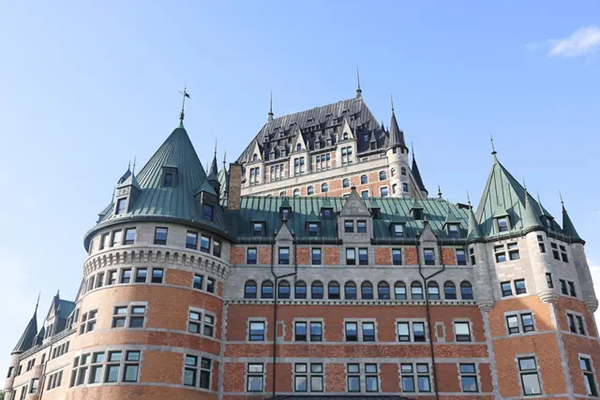
The capital of “La Belle Province” sits at the confluence of the St Charles River and the Gulf of St Lawrence in south-east Canada. Founded in the 17th century, the city still has an encircling wall, a historic civil engineering work and the only one of its kind remaining in North America. You will love the postcard-perfect stone houses of Old Quebec, the historic district listed as a UNESCO World Heritage site. Shopping is a pleasure in pedestrian streets such as Petit-Champlain Street, or you can relax over a spruce beer, seasoned with pine buds. Dufferin Boardwalk, an esplanade near the emblematic Château Frontenac, is the perfect place for views of the river and old city.
Located at the mouth of the Saint-Maurice River on the northern shore of the St. Lawrence River, halfway between Quebec and Montreal, Trois-Rivières is considered to be one of North America’s oldest towns. Founded in 1634, it stands out for its rich history, its perfectly preserved architecture and its historic sites, such as the Ursuline Monastery and the Old Prison. Fall under the spell of its dynamic cultural life as you stroll around its picturesque streets between old churches, museums and art galleries, romantic parks and lively cafés.
Famous for its gentle way of life, Montréal, Canada’s second-largest city, is a warm and cosmopolitan metropolis. Situated on the eponymous river island, it is home to a multitude of districts, each as unique as the other. Set off to discover Old Montréal, most of which is declared a historic area, Little Italy, where you’ll be able to stroll around the largest open-air market in North America, or the Golden Square Mile, the luxurious district located on one of the hills of Mount Royal and which has sumptuous Victorian-style residences. Simultaneously marked by the influences of the Old Continent and North-American gigantism, Montréal will never cease to amaze you.
Inclusions
²Excluding premium à la carte beverages.
Exclusions
Sort by